
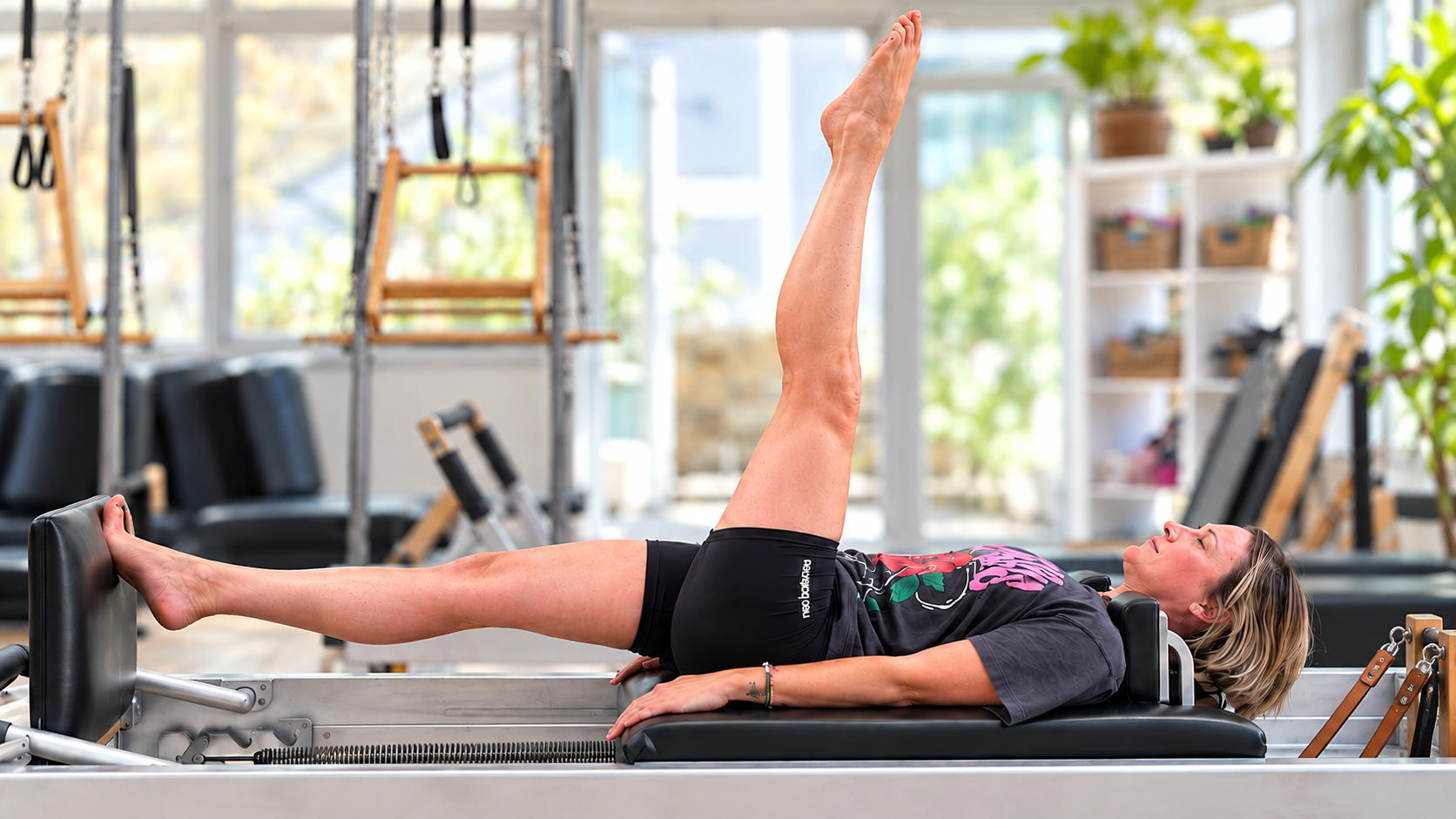
Your Body’s Continual Chatter.
The conversation between body and brain never really stops. Pilates gives us a way of listening to it.
The conversation between body and brain never really stops. Pilates gives us a way of listening to it.
Our bodies are talking all the time.
Not in words, but through an extraordinary and continuous exchange of information.
Where are my feet?
How much weight am I carrying through one side?
Where is my head in relation to my pelvis?
How much force do I need here?
Am I balanced?
Do I need to adjust?
Much of this happens without our conscious involvement.
This is proprioception: our internal sense of where the body is in space and how its different parts are relating to one another.
It is sometimes described as a sixth sense.
Unlike sight or hearing, proprioception does not have one obvious sensory organ. Information is gathered from receptors throughout the muscles, tendons and joints and continually communicated through the nervous system.
It is a kind of quiet chatter between body and brain.
And it is fundamental to how we move.
The body is always listening
Stand still for a moment and notice your feet.
Even in apparent stillness, your body is making countless tiny adjustments to keep you upright.
Shift your weight slightly forward and another conversation begins. Your ankles respond. Your calves change their tone. Your centre of gravity moves. The rest of the body reorganises around it.
You don't need to instruct each part individually.
Your nervous system is receiving information, interpreting it and responding.
Movement is therefore not simply something the brain tells the body to do.
It is a conversation.
Information travels both ways.
Pilates gives the body something to respond to
This is one of the reasons the Pilates apparatus is so interesting.
A spring is not simply resistance.
It gives information.
Push into it, and it pushes back.
The footbar tells us where the foot is. The straps communicate tension through the hands or feet. The carriage moves beneath us. The arc of a barrel changes our relationship to gravity.
Each creates a boundary, a direction or a response.
The body receives that information and has to organise itself around it.
Sometimes this makes something immediately apparent.
Perhaps one foot presses more strongly than the other. One hip takes over. A shoulder grips. We discover that what felt centred wasn't quite centred at all.
That discovery isn't failure.
It is information.
And once we can perceive something, we have the possibility of changing it.
Repetition becomes refinement
This also changes the way we might think about repetition in Pilates.
We aren't simply repeating an exercise in order to become stronger or more flexible.
Each repetition offers another opportunity for the nervous system to receive information.
To compare.
To adjust.
To refine.
The movement may look almost identical from the outside, but internally something quite different may be happening.
A little less effort.
A clearer sense of the feet.
A more organised pelvis.
A shoulder that no longer needs to help quite so much.
A movement that once required considerable conscious attention gradually becomes available with less effort.
The body learns.
And that learning leaves the studio with us
Perhaps this is one of the quieter gifts of Pilates.
The work does not end when we step away from the Reformer or leave the studio.
The nervous system takes its learning with us.
Into the way we stand.
Walk.
Climb stairs.
Reach for something on a shelf.
Carry a bag.
Catch ourselves when we stumble.
Move through the world.
Over time, the aim is not to become increasingly dependent upon instruction from a teacher.
It is almost the opposite.
We are developing a body that can sense more clearly and respond more intelligently.
A teacher may initially help us notice what we cannot yet perceive ourselves. The apparatus may make a relationship clearer. A hand may offer direction. A spring may provide the feedback we need.
But gradually the listening becomes our own.
And perhaps that is one way of understanding what a movement practice really is.
Not simply teaching the body how to perform movements.
But refining the conversation already taking place within it.
The body is always talking.
Practice teaches us how to listen.